Audiovisual – Motion Graphics
Editorial
Photography


Windows of
Bolin Aiyue
A six-steps pattern
of observation, 2021
When confined at home for long periods of time as it happened during the Covid-19 crisis, windows become one’s only natural contact with the external world. They can be studied from different orientations, from inside and outside, and it is through a pattern of six steps that one may complete a cycle of observation.
The residence and the building
Consider a window. Is it simply a void traversed by a line of sight? No. In any case, the question would remain: what line of sight – and whose? The fact is that the window is a non-object which cannot fail to become an object. As a transitional object it has two senses, two orientations: from inside to outside, and from outside to inside. Each is marked in a specific way, and each bears the mark of the other. Thus windows are differently framed outside (for the outside) and inside (for the inside). Henri Lefebvre, The production of space, 1991, p.209
Who hasn’t been impressed by modern Chinese architecture upon arriving in Beijing, marked by its utilitarian, Lego block-style structures with massive forms and minimal decorative elements? Bolin Aiyue, also known as the Berlin Philharmonic, is one of these residences built in 2008 and situated in the eastern outskirts of Beijing, comprising thirty-eight buildings from six to twenty floors, with thousands of residents of diverse social classes. From October 2017 to June 2021, I lived on the fourteenth floor of one of these buildings, where its windows were at the core of this visual research project, as they connected the inside and the outside world in ways that I attempted to study.

Research question: How to study my own windows and those of my residence from different inside-outside orientations?

First and last photograph of the view from my northern windows: October 2nd, 2017, and June 22nd, 2021
Following Lefevre’s analysis of the window, my proposal entailed to explore and classify these orientations across six chapters, where the relation between observer and observed—be it the windows themselves or what is seen from them—is the constant that gave a common thread to the project’s reflection and experimentation stages. In these six chapters, artist’s references were commented and visual experiments were conducted, starting with the most mobile and common of observations, when walking within the residence looking at others’ windows from the outside. Subsequent chapters were rather settled in one space, my own apartment and its surroundings, which reduced the range of the study, unless one considers the distant view from my windows. Finally, the last chapter was the most complex as it involved four of my neighbours and their respective windows. What initially started as a project alone, within my apartment, expanded by being shared with others.


From outside
to other windows
Windows: Part 1
There are the things that are out in the open and then there are the things that are hidden, and life has more to do, the real world has more to do with what is hidden, maybe. You think?
In No Great Hurry: 13 Lessons in Life With Saul Leiter, Tomas Leach, 2013, min.45–46.
When André Vicente Gonçalves undertook his photographic project ‘Windows of the world’ in 2009, he examined not only the shapes of windows but also everything surrounding them—materials, colours, balconies, architectural details, planters, curtains, objects—demonstrating that windows within the same city share many similar elements. What the artist and the viewer do not know, for obvious reasons, is what occurs within those spaces. Even after living in a building for years, one becomes acquainted with neighbours, but may have never entered their home, wondering who they really are and making suppositions about how they live. In a sense, Adas Vasiliauskas' quarantine portraits (2020), have attempted to provide us with a glimpse of families at their windows by using his drone; however, these were staged scenes rather than authentic moments of indoors life that could tell us more about society.


During the initial months of the Covid-19 crisis, while strolling through the alleys of the residence, I took numerous photographs of buildings’ windows, paying closer attention to the architecture during daylight and to social life at night. However, since most windows lacked curtains, ethical concerns arose if I was invading people's privacy by photographing their windows intrusively without their consent. For the sake of the project, I focused my attention on lights and the few objects placed near the windows, mainly hanging clothes, rather than on individuals in compromising situations. I frequently noticed that amidst the multitude of windows, the contrast between cool and warm lights mingling with the darkness of the night not only evoked a sense of magic, but also smallness in facing such dazzling presence of life. I would contemplate these lights as artistic compositions that triggered my imagination, as behind them could be a family sharing dinner, a father telling a story to his daughter, people doing sport, a couple watching TV or making love. A lightened room hides infinite possibilities that do not necessarily need to be seen but rather imagined. It is this reverie without malice that could almost free us from temporality, awakening an echo that is hopeful towards life in its various forms.


From outside
to my windows
Windows: Part 2
What makes the very first glimpse of a village, a town, in the landscape so incomparable and irretrievable is the rigorous connection between foreground and distance. Habit has not yet done its work. As soon as we begin to find our bearings, the landscape vanishes at a stroke, like the façade of a house as we enter it. It has not yet gained preponderance through a constant exploration that has become habit. Once we begin to find our way about, the earliest picture can never be restored. Walter Benjamin, One-way Street, 2016, p.63
After looking at other people’s windows, a rather amusing experiment was to observe my own windows from the outside, narrowing the surveyance to a single, specific area. Situated on the fourteenth floor of a high building near Chaoyang North Road, my windows faced west and north, most of them measuring 1.35 meters in height, except for those on the bedroom’s closed balcony, which were bay windows replacing the wall. From outside, these ones stood out with their white frames and their broken wooden bars on the left; the bathroom window also differed from others with its mosquito net pulled up; while my northern windows had Christmas stickers, facilitating their identification from across the street. It was then, seeing them changed, that I realised how I would never again feel that first irrecoverable impression of my building—that day of October 2017 I knew this was the place where I was going to live.

Alper Yesiltas' window project.


Series of photos capturing my own windows from different points of view.
While researching, I recalled that the photographer Alper Yesiltas (2017) used to capture a window that faced his room over twelve years (2017), and even if it wasn’t his own; one suddenly perceives it as a living entity. We can see its white lace curtain, its wall changing colours from snowy to sunny days, and how the passage of time gradually transforms the window until it is eventually dismantled, disappearing much like life itself when one passes away. This active contemplation of the same window over time shows a rare perseverance in representing the same element until it becomes an obsession. In my photographs, I opted to examine my windows from varying distances and angles, rather than relying on a single frame of reference, and I even asked two neighbours to take them in picture from outside, after giving instructions on how to recognise them. Sharing my exact location with others momentarily diminished my sense of privacy, yet I began to imagine myself as a stranger looking at these same windows years or even decades later—the only remaining entrance to that previous life I once had.

From my windows
to outside
Windows: Part 3
He who walks down the street, over there, is immersed in the multiplicity of noises, murmurs, rhythms […] By contrast, from the window, the noises distinguish themselves, the flow separate out, rhythms respond to one another. Towards the right, below, a traffic light. On red, cars at a standstill, the pedestrians cross, feeble murmurings, footsteps, confused voices. Henri Lefebvre, Rhythmanalysis, 2013, p.38.
There comes a moment when orientations shift, as it is not from outside that observation happens anymore, but from inside, from the immovable window. When researching paintings such as ‘Goethe at the Window’ (1787) by Johann Heinrich Tischbein, ‘Woman at a Window’ (1822) by Caspar David Friedrich, or ‘Early Morning’ (1858) by Moritz von Schwind, subjects are seen from behind, gazing out of an open window while details of trees, mountains or buildings are barely visible through them, as the painters were more concerned with the interiors. We begin to see details of Parisian streets from Gustave Caillebotte’s impressionist balconies, yet the entire spectacle seen by the subjects was still not shown to us.
More recently, in the last decade, Canadian painter Shaun Downey depicted lonely, contemplative women in their apartments, some looking through windows in serene and elegant compositions either focused on specific elements happening outside, sometimes even using binoculars, or simply allowing their mind to wander freely, probably consumed by their own thoughts in this lonesome activity of introspective nature. Before Downey, American painter Edward Hopper captured memorable urban scenes that convey this loneliness, and it is during the Covid-19 crisis, that his painting ‘Cape Cod Morning’ (1950) was widely shared on social media, portraying a tense woman looking out a bay window, inciting the viewer to contemplate the uncertainties that might come in such isolated place—the fear of an unknown virus. When only half of a story is shown to us, suppositions grow stronger in the imaginative mind.


Beyond the subjects, their interiors and their internal experiences, we definitely want to know what people actually see from their windows, and it is with the advent of photography that the spectacle of the city was further unveiled.With a view on Washington Square Park from his 12th floor, photographer André Kertész captured fragments of city life from 1952 until his death in 1985, while from 1958 to 1985, photographer Ruth Orkin embarked on a comparable project from her 15th-floor apartment at 65 Central Park West in New York. They were both far enough from the ground to broaden their scope yet close enough to enter in people’s intimacy, capturing the parks and their near-by urban life. Similarly, in his documentary Hush (2003), Victor Kossakovski turned out his eyes towards his street in Saint Petersburg, not only documenting the Nietzschean sense of eternal return in the repeated repairs and cleaning of a concrete road over a year, but also the fragments that make the street captivating and uninteresting at the same time.
The unique vantage point offered by a window invites us to contemplate and engage with the view in a more attentive way, even more when this interaction happens every single day. By carrying this logic far beyond, one could capture mundanity with its cycles by choosing a static constant that would always be present, as Ukrainian photographer Yevgeniy Kotenko did by photographing a local park bench for a decade, from 2007 to 2017. The bench was visible from the kitchen window of his parent’s fourth floor apartment in Kiev, allowing him to document its encounters with people. Aside from capturing urban life, one must not overlook the window itself as a physical element with its own shape and materiality, which stands between the viewer and the outside world, as photographer Josef Sudek, for example, developed in a series of photographs taken of his studio window in Prague, from 1940 to 1954. The book titled ‘The window of my studio’ not only documents what happens through the window but also presents the changes in its appearance over time, from clear glass to frosted or water-dappled, depending on the days.


From all these references, I explored a series of observations from my windows, compiled into a fifteen-minute video. If I had to describe what I used to see from my north-facing windows, there was Chaoyang North Road, along with an ancient mosque behind, followed by a school and numerous buildings in all directions, with distant mountains visible only on clear days. From my west-facing windows, the residential buildings were on the left and front, then an animated resting area just below and the road on the right. For months, I have photographed the same drying racks of this communal space, capturing the subtle variations in colour as different people brought their bed sheets to dry. Then, on May 22nd, I recorded the sights and sounds from that same window at three-hour intervals over twenty-four hours, capturing these visual and sensory fragments before seven o'clock for seven consecutive days.
Exploring the area’s rhythms in such way allowed me to witness the movement of the sun and to hear different sounds appearing besides the cars. If I was asked about the moments that I enjoyed the most from my windows, it was between six and eight in the morning, when I could hear birds chirping, people exercising and the megaphone of a man repairing electronic devices. Why that sound? It was somewhat reassuring to know that life was carrying on as usual. I felt the same in summer evenings, between seven and eight, as I used to enjoy the sound of children playing and women dancing, especially when it was Wang Qi’s song Standing and Waiting For You For Three Thousand Years (站着等你三千年) around a quarter past eight.


Drying racks, benches and a playground area seen from my bathroom window


View from my living room window.

Video making from my bathroom window.
While I appreciated the sounds from the western windows, I admired the views from the northern ones. From my hidden perspective, I have filmed the mountains, observed the end of the fasting month of Ramadan at the mosque as well as witnessed people walking and working on the street. If we were more individuals acting that way, we would become the street watchers defended by urban writer Jane Jacobs as the ‘eyes upon the street’ that may bring more safety to a city in being ‘the natural proprietors of the street’ (1961, p.35). As attentive citizens, we would provide a valuable understanding of a street or residence, yet we would need to debate on how these eyes are present and respond to what is observed.
If you are in China, you may have to activate your VPN to watch this video.
Lastly, inspired by the paintings described earlier, I photographed myself as the subject inside his room looking out through his four windows. These self-portraits constituted a sub-category, highlighting how my body posture and interaction varied with each window, as I was typically seated at my desk when outlooking from the living room window, whereas I would stand when observing through the other windows of my apartment. While this chapter focused more on what was seen outside, it did not omit the observer and the window from which such observation happened. Having said that, this exploration of the window in its physicality and impact on indoor surroundings was taken a step further in the next chapter.


From my windows
to inside
Windows: Part 4
This dim coolness of my room was to the broad daylight of the street what the shadow is to the sunbeam, that is to say equally luminous, and presented to my imagination the entire panorama of summer, which my senses, if I had been out walking, could have tasted and enjoyed only piecemeal. Marcel Proust, In Search of Lost Time, Swann’s way, p.114.
Vermeer’s mastery lies in his ability to represent the light coming into his studio from a left-side window, but it is again Edward Hopper that mesmerizes me. ‘Sun in an Empty Room’ (1963) probably stands as a pinnacle of his exploration of sunlight on the floor and walls of an empty apartment, creating rectangular bright and dark shapes that vary with the orientation and shape of the window. The intensity of light and the surfaces it illuminates also affect colour shades, as the effects of light on a green concrete wall will not be the same as on a parquet floor. Following these findings, I sought to photograph these effects in my four rooms to reveal such shades. Metaphorically, from my windows to ‘inside’ did not only mean that the ‘outside’ went into a room but also into myself, my wife, and the way light—or its absence—shaped our mood, our awakening, and our sense of what the day might hold for us.


Beyond providing light and views, windows serve various practical functions in daily life, here as everywhere else. After a shower, we used to open the bathroom window to let the floor dry, and after cooking, both the kitchen and bathroom window were opened to dissipate odours. In winter, the afternoon sun on the closed balcony warmed up the bedroom while in summer, we opened them up to ventilate the apartment and avoid air conditioning—actions that would seem familiar to any reader. To prevent the door from slamming shut when the windows were open, I used a shoelace to tie the door handle to a metal towel holder, and we would put the mosquito net to keep insects outside, which paradoxically obstructed our view. The same happened when we opened the window for fresh air as we got in turn more dust inside, as if it was inevitable for a window to have this dual role. While windows are mainly a functional element, some may completely lack of practical utility, while others are adorned with decorations, like the large illustrations and Christmas stars we added, leaving us with a rather strange fairy touch inside the apartment.


Light effects coming from my windows.


Other functions than light.

From my windows
to other windows
Windows: Part 5
That's a secret, private world you're looking into out there. People do a lot of things in private they couldn't possibly explain in public. Rear Window, Alfred Hitchcock, 1954, min.75.
In Edward Hopper’s 'Night Windows' (1928), we see the half-figure of an anonymous woman depicted near the illuminated windows of her apartment at night, unaware that she is being seen by voyeuristic viewers, whether the artist or the spectators of the artwork. Although the viewer could be on the street watching this mysterious and erotic display, the point of view is higher and may suppose it is observed from the window of another building. The painting looks like a frame of Alfred Hitchcock’s film ‘Rear Window’ (1954), where the woman could be a neighbour of the photographer L.B. Jeffries, played by James Stewart. As he spies on his neighbours and gives them nicknames, he discovers a murder by getting his voyeuristic practice beyond ethics, crossing the line between private and public space. Driven by curiosity, incessant watching can lead one to get entangled in people’s life, sometimes with unimaginable consequences.
In the short film ‘The Neighbors' Window’ (2019), a couple spies another couple’s window and is surprised to discover, in the end, that they were being watched by that same couple all this time. Some people may act driven by impulse rather than common sense, stealing what should not be stolen, our privacy, freedom, and vulnerability. Works by photographers like Merry Alpern (1995), Gail Albert Halaban (2009), Fosi Vegue (2014) or Yasmine Chatila (2016), reveal how controversial it may be accessing anonymous apartments under the cover of the night, unveiling ordinary scenes or, in some cases, sexual activities. The totalitarian society of surveillance is criticised by all of us as free citizens, but when individuals seek to keep an eye on their neighbours with their camera, they are called artists.


What is even more paradoxical is that those who photograph people would certainly not accept being photographed themselves. Drawing the curtain and turning off the light is a plea for privacy, to avoid being seen by others at night, as ‘we never look at just one thing; we are always looking at the relation between things and ourselves […] Soon after we can see, we are aware that we can also be seen. The eye of the other combines with our own eye to make it fully credible that we are part of the visible world’ (Berger, 1972, p.9). In this given context, Duchamp’s ‘Fresh Widow’ (1920) with the panes of glass covered in black leather could shield us from the outside world but could also confine us in our solitude, much like a window facing a wall. While I may have watched my neighbours at times, as the deranged artists described earlier, I have avoided them in most of my photographs, capturing only their silhouettes and focusing on interiors as if their windows were the frame of an artwork, a metaphor borrowed from René Magritte’s ‘The Human condition’ (1933) and his series of broken windows.


From my neighbour's
windows
Windows: Part 6
...The drama of a disillusioned man who threw himself out of a tenth storey apartment and whilst falling saw through the windows the private lives of his neighbours, the small domestic tragedies, the clandestine loves, the brief moments of happiness, news of which had never reached the public stairwell, so that at the instant of crashing against the pavement he had completely changed his view of the world and had reached the conclusion that the life he was abandoning for ever by the false door was indeed worth living.
Gabriel García Marquez, Untitled tale, n.d.
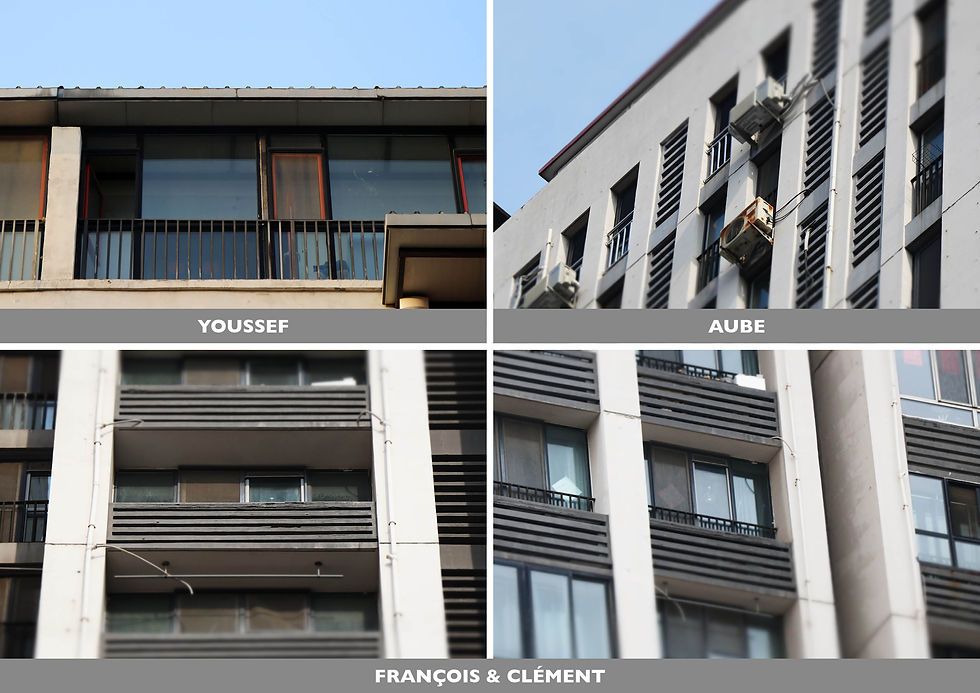
The final chapter of this project aimed to let aside my experience with my windows to rather understand those that residents of Bolin Aiyue have with their own. For that, I engaged four former francophone colleagues living in the compound to participate in this investigation, leveraging a convenience sampling approach on location and availability of foreign respondents. Further selection criteria included residency of more than six months and mutual trust between us as researcher and participant. I then conducted semi-structured interviews in the participants’ apartment in late February 2021, lasting approximately 30 minutes each, to gather detailed insights into their past and present window experiences.
In the data collection phase, with a tape recorder in hand, I recorded the interviews to capture nuances in participants’ responses, which facilitated subsequent analysis, and I took photographs and videos of the discussed windows as well as their views, enhancing the visual representation of their narratives. In the data analysis phase, I listened to the interviews several times, then transcribed and analysed them, while I employed post-it notes to synthesise key points from each participant’s responses. Inductive clustering of these points allowed me to identify overarching themes, structure my findings in the following paragraphs and lastly, make a video to visualise parts of our discussions and let the viewer sense, to some extent, my neighbours’ thoughts, stories and ways of seeing their own window.
Profiles and interview structure
Participants were composed of three males and one female, one of which was Moroccan and the other three were French. At the time of the interviews, Youssef resided on the seventh floor of a smaller building within the complex, having lived there for six months. Aube resided on the nineteenth floor of a twenty-floor building, having resided there for a year and a half. Clément and François resided as roommates on the sixteenth floor of Aube’s building, with Clément there for nearly two years while François for only six months. I encouraged participants discuss their experiences with their preferred window; however, François chose to discuss the window he disliked the least. Selected windows were mainly situated in the living room, apart from Youssef who chose his bedroom window as it was for him the only one available to establish a real bond with. Interviews were therefore structured to progress from descriptions of participants’ observations and opinions of their windows to reflections on their personal preferences for living spaces. This approach facilitated a comprehensive understanding of participants’ relationships with their windows, encompassing their observational skills, understanding of urban environments, personal memories, and imaginative responses to hypothetical scenarios.


Sights and sounds
The four respondents, situated at different heights, could mainly see buildings, streets, cars and pedestrians, indicative of the urban landscape. From their sixteenth floor with south orientation, Clément and François had a panoramic view towards a high school stadium and the cityscape with its huddled buildings. Aube, from her nineteenth floor with west orientation, had a front view on a building, but she could also see inner pathways of the residence by turning her head to the right. As for Youssef, he could see close enough the main pathway of the residence with its trees, cars and residents from his seventh floor with south orientation.
Beyond this objective description of what interviewees observed, their emotions soon appeared when asked about their preferences and dislikes regarding their current view. For Clément and François, the high school stadium and adjacent kindergarten gave vitality to the area when students were around, but François highlighted that otherwise ‘there isn’t much to see as the view is a bit sad with these buildings all around’. Both agreed that the view was rather static, lacking in variety, dynamism, greenery and colours that could arise their curiosity. While Clément said that ‘in ten years the view will still be the same’, he was rather happy with this large window as it gave ‘the feeling of having western style verandas’, offering abundant brightness and a wide perspective which, based on his experience, was quite unusual in China.
Aube appreciated the variety of her window’s view, which blended urban and natural elements, including the scenery and hum of the city, but also the moon, sunrises and sunsets, the movement of Venus and, most importantly to her, the presence of the mountains in the morning when the sky was clear. In Aube’s words, ‘at every moment, something will be missing as it’s the time of the day that reveals or hides what we see’. These variations are part of a routine that calms us all unconsciously by confirming that the Earth is still moving around the Sun and that life goes on outside despite one’s good or bad day. Aube compared her monitoring of these daily cycles to that of a concierge who would ensure that everything remains in order. In contrast, Youssef, deprived of these views and what happened beyond the residence, found enjoyment in a nocturnal habit of counting the windows that, ‘like his’, were still lightened at one or two in the morning, when everyone was sleeping. He certainly appeared more neutral compared to Aube and Clément’s evident enthusiasm or François’s discontentment with their respective views.
A window’s view could evoke both positive and negative experiences. When asked about urban sounds, Aube expressed being ‘relatively deprived from noises’ due to her apartment’s height. While she did perceive the city hum, it did not disrupt her calmness as it made her feel ‘with other humans’. However, when asked about disliked sounds, Aube explained how she investigated for days to identify the source of recurrent shouting. She recounted being scared as she ‘couldn’t understand why these men were shouting that loud and that early’ and thought they were fighting, only to discover it was military exercise nearby. Aube acknowledged her difficulty in filtering out noises, recalling an afflicted dog bark for weeks as other example that she interpreted as signs of distress.
As these sounds were repeatedly heard every day, they became familiar and she got used to them, even detecting the times of the day they had to be heard; late afternoon for the dog and early morning for the military salute. Aube also noted the sound of cats in heat resonating between buildings, concluding that she ‘would like to hear birds’ but she could only hear ‘cats, dogs and people shouting’. When listening to her, I felt that she generally perceived a sense of calm from her windows, although a series of sudden and distinct sounds were often felt unpleasant. Similarly, as François and Clément lived in the same building, they could also hear these cats in heat. François lamented that ‘we rarely hear nice things like music’ while Clément complained about the view of the residence’s landfill and the disruptive noise of dump trucks every week for three or four hours, breaking the ‘monotonous atmosphere’ that they usually had at home, ‘as if suddenly we were moving from one environment to another’.
Functionality
Apart from the view it offers, a window can hold significant value for its inherent qualities. Youssef highlighted several attributes from his double-glazed window as they formed a closed balcony that was ‘like a heater’, comfortable but also practical to dry clothes. He also emphasised on natural lighting as the window helped him waking up earlier, and then, noise isolation, probably due to the double-glazing and for being located inside the residence rather than near the road. Ventilation was another essential aspect for Youssef, as he mentioned the importance of a well-ventilated room and, lastly, he noted the overarching benefit of a window in reducing energy consumption. Natural light reduced the need for artificial lighting, and its heating or ventilation functions could alleviate the necessity of using air conditioners or heaters. Youssef had truly become an expert of his own window through these observations, especially, when mentioning the occasional noises produced by the glass as it cooled down at night after being all day warm, which turned out to be true as I could hear a ‘toc’ every two minutes while interviewing him.
A window can also have the function to change our perceptions of life indoors and outdoors. Initially, the window that Aube discussed with me was not her favourite one as it proved to be too small for her liking during the first months in the apartment, but she found it every time more interesting due to the variety of its view, which started to impact her mood positively. In contrast, Aube thought that the window’s emplacement could allow neighbours to see her and her daughter from the facing building, which incited them to draw the curtain when watching films in the living room. Aube reflected on this need for privacy, remarking ‘I do not want to be seen and I know it’s a way for people to see me’, contrasting this with the earlier sensation of the window as a portal to fly away to the outside world. In a final anecdote, Aube revealed that she had overcome her fear for heights with this nineteenth-floor window, whereas it was her daughter who had to remind her to be cautious when leaning out.
As Youssef earlier, François saw his window as a source of light and ventilation for the living room, allowing him to wake up more easily in the morning. Interestingly, the window served the function of distracting his cat, Robin, when opened, while the mosquito net could protect him from falling. Clément even added that Robin had his ‘own little corner to rest and enjoy the sun’ as they installed a cat window perch. Despite these practicalities, François ironically despised his window once more, claiming it had little effect on his own mood. In contrast, Clément insisted on the virtues of his large windows, which flooded the room with light, and were aesthetically pleasing, seamlessly blending with the apartment’s interior décor. He also noted the skyline’s utility as an indicator of pollution if buildings were covered, and wind intensity if trees were swaying. Further, there was a major divergence between Clément and François regarding the window bars, given that the former appreciated the sense of security they provided while the latter felt they deprived him of his sense of freedom. It was quite amusing to see how the same window could be perceived differently by two individuals living in the same apartment.
The feeling of being in China
Participants brought contrasting perspectives when asked if they felt like being in China when looking through the window. Aube said that, at least, she felt not being in Paris as ‘it doesn’t smell like Paris’, and Clément confirmed that he didn't feel being in France or Europe. Interestingly, Aube was the only respondent who did not strongly associate her window view with China. She described it as ‘a somewhat ugly suburb of Dijon or Brest’ while François suggested it could be mistaken for a Parisian suburb if not for certain details such as the façades, Chinese flags or red stickers on the windows, all characteristic of the Chinese urban landscape. While reflecting on these cultural identifiers, I saw that François, Clément, and Youssef had the Fu character adorning their windows, symbol of good fortune, which Youssef noted as emblematic of Chinese windows.
During the Chinese New Year, Youssef definitely felt like being in China amidst the display of red lanterns, knots and door couplets, all decorative elements integral to the culture and visible from his window, while Clément and François had that same feeling by seeing fireworks from theirs. Further, Clément identified huddled buildings and the absence of shutters as key indicators of being in China, wondering how his neighbours manage to sleep without complete darkness. Aube also acknowledged that when looking into others' apartments, she found ‘people without curtains, who are not hiding, with sad and poorly lit interiors’. At the end, despite being curious to know more about how their Chinese neighbours live, all four participants concurred on the importance of privacy, acknowledging the need to disconnect from the outside world, especially at the end of the day. In a way, it almost feels that ‘home’ is a timeless, spaceless cocoon, which doesn’t necessarily need to be situated in any specific country, unless the outside world calls for our attention and pulls us back to ‘reality’.


Past windows
In the realm of experiences, windows play a pivotal role in shaping our preferences and aversions when it comes to living spaces, influencing our room selection. During their quarantine stay in Shanghai, Aube and her daughter were allocated two rooms with only a few minutes given to visit them. Aube did not take the room with the walled-up window but the one with the bay-like window, around which she created her world. While her daughter did not notice any difference, Aube noticed it instantly and concluded that ‘a window is an eye, a tunnel to go away’. With just a few minutes to decide, windows become a reliable indicator in imagining life in a space.
Similarly, in a past trip to Benin, François was allocated a room with small windows only for ventilation, preventing him from enjoying outside views. Disappointed, he opted to spend his time in an office upstairs with a large bay window and a balcony, as they would provide abundant natural light. Interestingly enough, here are examples of people who still had a choice in selecting their room, but what might occur in situations where options are unavailable? In his first years in Beijing, Clément had roommates who lived in narrow rooms resembling closets, ‘long enough to put a bed and a wardrobe’, and obviously lacking windows—a condition he deemed ‘unthinkable’. Similar to Aube’s experience, he once rent a room in a hotel with a window facing a wall, providing him a glimpse into what it might feel like to be deprived of a view. This is when Clément reinforced his appreciation for the windows in his apartment, particularly during the confinement period from February to May 2020. In this regard, all four participants emphasised the significance of windows during the Covid-19 pandemic.
Our encounters with windows weave together parts of our lives, capturing our fears, frustrations, joys, and aspirations—all sort of memories. François remembered his grandfather’s attic windows as they had bars that restricted his field of vision, contrasting with the playful freedom he found in the skylight of his childhood bedroom. Similarly, Aube recalled her grandmother’s nineteenth century Balzacian house with their bull’s-eye windows, charming from outside but intimidating from inside. Reflecting on her own past, Aube expressed disappointment with the places she has lived in where windows failed to offer expansive views, often showing uninteresting things. Aube always expected windows to satisfy her. Her current window met these requirements as she started to turn her head to the right, but this was not the case initially. Aube concluded saying that before complaining she should better learn to look for what her windows hide; ‘we have to tame each other, I have to tame the sight.’ In her experience, windows have often frustrated her at the beginning but sparked intrigue later on, and it almost feels as if windows should provide the view we want without effort, much like when an audience complains of artworks that hide their deeper meanings. However, when Clément recounted an unusual experience in France where a colony of ladybugs invaded the joints of his sliding windows, preventing him from opening them despite having a pleasant view of a park, it made me think that often external factors, such as pollution or, in this case, ladybugs, can truly hinder a window’s daily usage and frustrate us over time.
Ideal windows
Past experiences and future expectations regarding windows are deeply intertwined, as a positive or negative memory can shape our preferences. For example, growing up in a house with wooden windows, as it happened to Clément, might instil a desire to recover that same feeling of warmth. Our window preferences can also be influenced by personal or collective imaginaries; when asked about their ideal window, most respondents expressed a desire for large bay windows. Youssef and François dreamed of a view overlooking the sea—a terrace with a beach view for Youssef, where he could listen to the sound of breaking waves, and a lighthouse hit by a storm for François. Youssef also yearned for a garden with trees, similar to Clément’s call for more greenery, highlighting the widespread desire for natural surroundings.
It was also interesting to ask participants to explain how they would change their current window through practical examples rather than idealised ones. For example, if only asked to change the view, François would remove buildings to see what is behind, ‘if there is a park or something interesting, something other than buildings’ while having a closer glimpse into people’s daily lives. If asked to change the window’s features, François yearned for a larger window without bars and mosquito nets as well as replacing the dusty curtains into shutters. Additionally, he would have liked to enjoy his cigarette on a balcony, as he could do when he was living in Youssef’s room a year earlier, as it seemed to be a calm ritual that he missed. Lastly, if asked to change a situation affecting their window’s current use, François lamented the inability to fully open them due to his cat, highlighting once more how everyday constraints can reshape one’s relationship with a window.
Participants were asked to envision their ideal windows, which naturally led to discussions about the ones they would avoid. Drawing from their past experiences, I knew François would steer clear of small windows with bars, while Aube and Clément would avoid walled-up windows. However, one’s aversion to certain window types might also stem from what has been observed rather than directly experienced. In this regard, Youssef expressed his dislike for windows that couldn't be closed easily, when it should be their main function, as well as windows directly facing his own, because ‘even if you just want to have a look, you may see other people’s private life’. Youssef then explained his disdain for ground-floor windows for privacy but also security reasons, as they could be easily accessible to intruders.
Life without a window
When asked about the possibility of living in a room without a window, François reflected thoughtfully about it, that windows not only ventilate and provide natural light, but also a connection to the outside world: ‘In itself it is true that the window, through little things, we wouldn't say, but it can incite us to go out in the morning, it can make us want to... Looking out the window, not the window itself, but looking out the window. It will make us want to... It will give us the temperature, if the weather is nice or cold, if I'm putting on a coat, I'm putting on a scarf, or not. I want to go out, I don't want to go out. I see olala there is pollution, I don't go out. Whereas if you don't have a window, you have to look on the Internet, and then, I don't see myself in a room without a window’. It is worth noting that the only participant who continuously expressed dissatisfaction with his window ended up sharing such opinion about its view.
François expressed discomfort at the idea of being physically and mentally confined without a window, and Clément added that ‘even for the mind, the morale, we need some sort of light, we need to see things outside in order to identify with this social, natural mixture’. By letting them imagine how a life without a window would be, led them reaffirm how important windows actually are. François acknowledged that he couldn’t change his windows easily as he could do with curtains: ‘I’m here for an indefinite period, so I have no choice, I have to adopt them as they are, to accept them as they are, with their defects and qualities’. This pragmatic approach reinforced the necessity to accept the windows that we have, here and now, in our everyday reality rather than in our imaginary.
If you are in China, you may have to activate your VPN to watch this video.
Bye bye windows
Rhythms: the music of the City, a scene that listens to itself, an image in the present of a discontinuous sum. Rhythms perceived from the invisible window, pierced into the wall of the façade…But next to the other windows, it is also within a rhythm that escapes it…No camera, no image or series of images can show these rhythms. It requires equally attentive eyes and ears, a head and a memory and a heart. A memory? Yes, in order to grasp this present otherwise than in an instantaneous moment, to restore it in its moments, in the movement of diverse rhythms. Henri Lefebvre, Rhythmanalysis, 2013, p.45.
With the insights from my four respondents, I have come to refine what I discovered in the previous chapters, that windows, despite being physical objects, they can be personalised and shaped by our shared experiences with them. Windows are essential for indoors life while keeping us connected to the outside. Alongside doors, they are the shape that can be opened and closed or seen through, situated between what is private and what is public. The sight and sounds they offer are an integral part of our daily routine, while our interactions with them and the stories they hold reveal how they fulfil our needs for light, air and activities, all the while showing us the weather and protecting us from polluted, dusty and stormy days. They remind us, above all, where we are in time and space, inviting contemplation and introspection. Reflecting on windows reveals a certain intimacy and lifestyle that varies from one person to another.
As a researcher and visual practitioner, my approach was inductive, piecing together fragments of information extracted from interviews and observations to inform broader frameworks of thought. As the windows of the residence Bolin Aiyue were my primary interest, interviewing Chinese neighbours could have come to complete the sociocultural interpretation of this project. By interviewing people about their windows, a designer or an architect could rethink interiors and exteriors, while it only gave me, for this project, new perspectives that I could not have explored alone. With this final chapter, the project ended after five months of work, from January to June 2021, although it started unconsciously the moment I first arrived at my apartment on October 2nd, 2017.
With these anecdotes and stories, we are offered endless perspectives to delve into, even more when counting the number of apartments in the residence as they show the even greater proportions that this project could have taken. While some people stay a lifetime looking from or at the same window, my few months of observation have only scratched the surface of understanding them. However, the project’s true value lied in its structured pattern of study, based on these six steps that can be used for future investigations into windows, to then produce a greater quality and quantity of experiments. Finally, much like my previous project ‘Details of a street’ was made before leaving my previous job, and hence the street I walked through during three years, this new project on windows was made knowing that we would have to move at the end of June 2021, after residing in this apartment for three years and a half. This predictable melancholy reappeared under different angles in these three visual projects in Beijing and increased my attachment to specific places of my direct environment while valuing their uninteresting mundanity that is not less representative of life itself.